Website Development Company in Pune: What Should Businesses Look For?

A website can make your business look established. But can it actually help your business grow?
Imagine two businesses offering almost identical services in Pune.
The first has a beautiful website. Large banners, impressive animations, attractive colours and plenty of photographs. But visitors struggle to understand what the business offers, the contact form doesn’t work properly, and the website takes too long to load on mobile.
The second has a simpler website. Its services are explained clearly, customers can find answers quickly, the contact options are visible, and every important page has a purpose.
Which business is more likely to earn a customer’s trust?
Probably the second.
This is something business owners often overlook when searching for a website development company in Pune. They compare designs, prices and delivery timelines, but rarely ask the most important question:
Will this website make it easier for the right customers to choose my business?
At Xpresso Solutions, we believe website development should start with that question.
Whether you operate a manufacturing company, professional consultancy, retail business, startup, restaurant or growing service brand, choosing the right development partner can influence how customers discover, understand and interact with your business.
Let’s explore what genuinely matters before hiring a website development firm in Pune.
1. Don’t buy a website. Understand what your business needs.
One of the most common mistakes businesses make is approaching developers with a design reference before understanding their actual requirements.
Someone shares a competitor’s website and says, “I want something like this.”
But does that competitor’s website solve the same business problem?
A manufacturer may need a detailed product catalogue, downloadable specifications and distributor enquiries. A local service provider may need service-specific landing pages, WhatsApp enquiries and location information. An online retailer needs product discovery, checkout functionality, payment integration and order management.
These are completely different development requirements.
Before approaching any web development company in Pune, consider:
- Who are your ideal customers?
- What information do they need before contacting you?
- What makes your business different?
- Do you need enquiries, online sales, bookings or brand credibility?
- Will your team regularly update website content?
- What should happen after someone submits an enquiry?
A good development partner should help you answer these questions instead of immediately selling you a package.
2. A portfolio is useful. Understanding the work behind it is more important.
Almost every website development firm has a portfolio.
However, a collection of attractive screenshots doesn’t tell you everything about a developer’s capabilities.
A website may look impressive in a presentation but perform poorly when someone opens it using a mobile connection.
When evaluating website developers in Pune, ask to see actual, working websites.
Then investigate them yourself.
Check:
- Does the website work properly on mobile phones?
- Can you find important information without searching everywhere?
- Do the contact forms actually work?
- Are the pages loading reasonably quickly?
- Does the website feel consistent across different pages?
- Is the navigation easy to understand?
There is another question worth asking:
What exactly did your development team build?
Did they customise a purchased theme, develop the entire website, integrate third-party systems or simply redesign an existing website?
There is nothing inherently wrong with using established themes or frameworks. What matters is whether the development approach fits the project’s requirements.
A reliable website development company should be comfortable explaining its contribution.
3. The cheapest website can become the most expensive one.
Let’s discuss something that rarely gets enough attention: the cost of owning a website.
Imagine receiving two proposals.
One developer offers to build your business website for ₹8,000. Another quotes ₹30,000.
Naturally, the first offer looks attractive.
But what happens when you need to add another service page? Who handles security updates? What happens if your website stops working? Can you move your website to another hosting provider? Will you receive complete administrative access?
The original quotation doesn’t answer these questions.
A website’s actual cost extends beyond its initial development.
Consider these possible expenses:
| Expense | What to understand |
|---|---|
| Initial development | Design, development and agreed features |
| Domain | Annual registration and renewal |
| Hosting | Server resources and renewal charges |
| Maintenance | Updates, backups and technical support |
| Premium tools | Themes, plugins and third-party services |
| Future changes | New pages, features and integrations |
A professional website development firm in Pune should explain which expenses are included, which are recurring and which may arise later.
The objective isn’t necessarily to spend more.
It is to avoid paying repeatedly for things you thought were included.
4. Your website should be built for the customer using a phone.
Many business owners review their websites on desktop computers during development.
But their customers may discover them while travelling, waiting for a meeting, comparing suppliers or searching for a service on their phones.
This changes how a website should be designed.
Mobile responsiveness is not simply making desktop content smaller.
It involves rethinking how information is presented.
For example:
- Important contact information should be easy to access.
- Navigation should work comfortably on smaller screens.
- Buttons should be large enough to tap.
- Text should remain readable without zooming.
- Images should fit the available screen space.
- Forms should be short and easy to complete.
A website development company that treats mobile optimisation as an afterthought is missing an important part of the customer experience.
Before approving a website, test it on an actual smartphone.
Not just the homepage. Test the entire enquiry journey.
5. SEO should influence website development before launch.
This is where businesses often lose valuable opportunities.
They hire a developer to build a website, launch it and then approach an SEO agency because Google isn’t sending traffic.
The problem is that some SEO-related decisions should have been considered during development itself.
For example, a website’s structure affects how visitors and search engines understand its content.
A well-planned website should consider:
URL structure: Pages should have meaningful, readable URLs.
Page titles: Important pages should have unique titles that accurately describe their content.
Heading structure: Headings should organise information logically.
Internal linking: Related services and resources should connect naturally.
Image optimisation: Images should be appropriately sized and include useful alternative text when needed.
Technical accessibility: Search engines should be able to discover and access important pages.
XML sitemap: Important indexable pages should be discoverable through a properly configured sitemap.
Analytics: Google Analytics and Search Console should be configured so the business can measure website performance.
These are not guarantees of Google rankings. Search visibility depends on competition, content quality, relevance, reputation and many other factors.
However, getting the technical foundations right gives a website a better starting point.
For additional guidance, businesses can read Google’s SEO Starter Guide.
6. Ask who owns your website after development.
This is probably one of the most important questions to ask before signing an agreement.
Your website represents your business. You should not have to depend entirely on a developer to access your own digital property.
Before starting a project, establish ownership of:
- Domain registration.
- Hosting account.
- Website administrator account.
- Website files and database.
- Website content and images, subject to applicable licences.
- Third-party service accounts.
- Analytics and Search Console properties.
Ask whether you will receive the necessary credentials and documentation at handover.
Also understand the difference between website ownership and ongoing technical support.
You should be able to own your website while choosing to retain the original developer for maintenance.
A professional relationship should be based on the value of continued service, not restricted access.
7. WordPress, custom development or an eCommerce platform?
Not every business needs a custom-coded website.
Sometimes the best solution is the one that provides the required functionality without introducing unnecessary complexity.
Here is a practical comparison.
| Platform | Suitable for |
|---|---|
| WordPress | Business websites, blogs and service websites |
| WooCommerce | Online stores and product-based businesses |
| Shopify | Businesses looking for managed eCommerce |
| Custom development | Unique workflows, specialised systems and complex applications |
For many small and medium-sized businesses, WordPress is a practical option.
It provides a flexible content management system, a large ecosystem of extensions and the ability to expand a website as business requirements change.
However, flexibility does not mean installing dozens of plugins without considering their purpose.
The right development team should recommend a platform based on your requirements, budget, maintenance capabilities and future plans.
You can also explore WordPress’s official documentation to understand the platform.
8. The real test of a developer starts after the website goes live.
Website launch day is exciting.
The design is approved, the domain is connected and the website is finally accessible to customers.
But what happens next?
A contact form might stop sending notifications. A plugin update might cause a compatibility issue. A new service might require another landing page. An employee might need help updating website content.
These are normal situations in the life of a business website.
This is why post-launch support deserves attention before hiring a development company.
Ask the following:
- Is there a defined support period after launch?
- Who handles website updates?
- Are backups configured?
- How are technical problems reported?
- Is maintenance available separately?
- What happens if additional functionality is required?
You don’t necessarily need an expensive monthly maintenance contract.
But you do need to understand who is responsible when something goes wrong.
9. Don’t compare website development companies only by price.
If you are comparing three proposals from different developers, a simple comparison can prevent an expensive decision.
| Evaluation factor | What a good proposal should explain |
|---|---|
| Discovery | Understanding your business requirements |
| Design | Layout, branding and user experience |
| Development | Platform and functionality |
| SEO foundation | Technical and on-page essentials |
| Performance | Image handling and speed considerations |
| Security | Backups and basic security measures |
| Ownership | Accounts, access and handover |
| Support | Post-launch responsibilities |
Ask each shortlisted company to quote against the same requirements.
A ₹15,000 proposal and a ₹50,000 proposal may not include remotely similar deliverables.
Without comparing scope, the prices are almost meaningless.
The right website development partner isn’t automatically the most expensive or the cheapest.
It is the one that understands the project, communicates honestly and delivers what was agreed.
10. Why working with a development partner matters more than simply hiring a designer.
A business website involves several interconnected decisions.
The design influences usability. The content influences understanding. The technical structure influences maintainability. The SEO foundation influences discoverability. The enquiry process influences whether an interested visitor takes action.
If these elements are handled without coordination, the business can end up with a website that looks finished but feels incomplete.
A capable development partner should understand how these elements work together.
At Xpresso Solutions, we approach digital projects with this broader perspective.
Our services include web development, WordPress development, app development, SEO, digital marketing and UI/UX.
We have worked across different business and creative requirements, with an emphasis on practical digital solutions rather than design for appearance alone.
Explore Xpresso Solutions to learn more about our approach and services.
11. A practical checklist before hiring a website development firm in Pune
Before making your final decision, use this checklist.
- The developer understands my business and target audience.
- I have reviewed actual live websites.
- The proposal clearly lists pages and features.
- Mobile responsiveness is included.
- Technical SEO requirements are discussed.
- Website speed and image optimisation are considered.
- Domain and hosting ownership are clear.
- I will receive administrator access.
- Recurring expenses are explained.
- Post-launch support responsibilities are documented.
- I understand what happens if I need future changes.
If a developer cannot answer these questions clearly, take some time before making the payment.
A little preparation can save considerable time, money and frustration.
Frequently Asked Questions
How do I choose the best website development company in Pune?
Start by understanding your requirements. Then evaluate the company’s live portfolio, technical knowledge, communication, project scope, ownership policies and post-launch support. Choose a partner based on demonstrated capability rather than marketing promises.
How much does website development cost in Pune?
Website development costs depend on the number of pages, design requirements, integrations, functionality, platform and support requirements. A basic business website is generally less expensive than a custom application or a feature-rich eCommerce platform. Always compare written scopes before comparing prices.
Is WordPress suitable for small businesses?
Yes. WordPress can be an excellent option for small and medium-sized businesses that need service pages, blogs, enquiry forms and flexible content management. The quality of implementation and ongoing maintenance matter considerably.
Should I hire a freelancer or a website development firm in Pune?
A freelancer can be suitable for smaller, clearly defined projects. A development firm may be more appropriate when you require multiple services, ongoing technical assistance, design and development coordination or a larger project team. Evaluate the actual people handling your project rather than relying solely on the company label.
Does website development include SEO?
Not automatically. Some developers include basic technical and on-page SEO foundations, while others treat SEO as a separate service. Confirm exactly what is included in your proposal.
Can I update my website without contacting the developer?
Yes. A properly configured WordPress website allows business owners to manage pages, blog posts, images and other content through the administration dashboard. Some advanced changes may still require technical assistance.
Why should I choose a local website development company?
Working with a Pune-based team can make communication, meetings and understanding of the local business environment easier. However, location alone does not guarantee quality. Experience, transparency and technical capability should remain your primary considerations.
Final Thoughts: Your Website Should Work as Hard as Your Business Does.
A website is often the first meaningful interaction a potential customer has with your business.
It should answer questions, establish confidence, explain your services and make the next step obvious.
It doesn’t need unnecessary animations, complicated features or expensive technology to achieve that.
It needs thoughtful planning, reliable development and a clear understanding of the people it is built to serve.
So, when searching for a website development company in Pune, don’t ask only how much a website costs or how quickly it can be delivered.
Ask what it will help your business accomplish.
That is a much better starting point.
Looking for a website development partner in Pune?
At Xpresso Solutions, we help businesses build their digital presence through website development, WordPress solutions, UI/UX and digital services.
Whether you are starting from scratch, replacing an outdated website or planning a more capable online presence, let’s discuss what your business actually needs.
Visit: https://xpressosolutions.com/
Email: info@xpressosolutions.com
Call: +91 86258 62086
Let’s build something that works for your business, not just something that looks good.
Why Your Website Gets Enquiries but No Customers
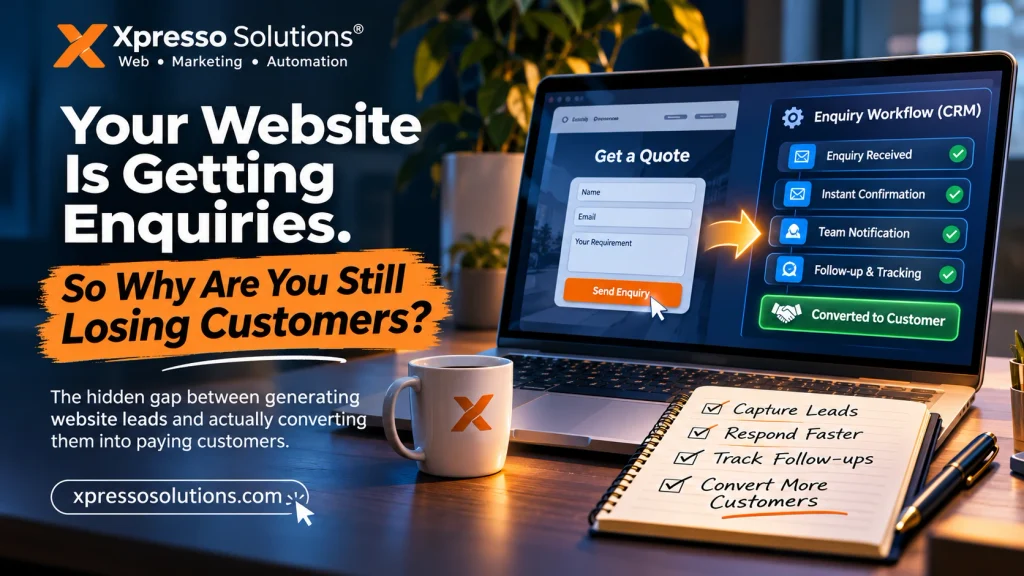
Your Website Is Getting Enquiries. So Why Are You Still Losing Customers?
The hidden gap between generating website leads and actually converting them into paying customers
A business owner invests in a website. Someone runs Google Ads. A few visitors arrive, explore the services and submit an enquiry form.
Everything appears to be working.
But there is a problem.
Nobody checks the enquiry until the next morning. The notification goes to an email address nobody monitors. A WhatsApp message gets buried under dozens of conversations. Another potential customer calls a competitor.
The business concludes that its website isn’t generating enough business.
But what if the website isn’t the problem?
What if the real problem starts after someone clicks the contact button?
This is one of the most overlooked problems in small-business digital marketing: the gap between lead generation and lead management.
At Xpresso Solutions, we believe a business website should do more than attract visitors. It should become part of a functioning customer acquisition system.
Let’s examine why this distinction matters and how businesses can fix it.
1. A website can succeed technically and fail commercially
Most website projects are evaluated using familiar criteria:
- Does the website look professional?
- Does it work on mobile devices?
- Does it load quickly?
- Are the contact forms working?
- Does it appear on Google?
These are important questions, but they don’t answer the most commercially important one:
Can a potential customer move from discovering your business to becoming a paying customer without unnecessary friction?
Consider a hypothetical local service business.
It receives 500 website visitors every month. Twenty visitors submit enquiries.
That represents a 4% enquiry rate.
However:
- Five enquiries receive no response.
- Seven receive a response several hours later.
- Four receive a generic reply without a clear next step.
- Four have meaningful conversations with the business.
The website generated 20 enquiries, but the business only handled a fraction effectively.
The problem isn’t necessarily traffic, design or SEO. It’s the system behind the website.
2. The invisible cost of responding too late
Customer interest is not permanent.
When someone visits a website and requests a quotation, they are expressing interest at that particular moment. They may be comparing multiple providers, working within a deadline or trying to solve an immediate problem.
Every unnecessary delay creates another opportunity for that interest to disappear.
Research published in Harvard Business Review in 2011 examined how companies responded to web-generated enquiries. Its audit of 2,241 US companies found that many businesses responded slowly or never responded at all.
A separate 2007 Lead Response Management study, based on more than 15,000 leads, examined how response delays affected contact and qualification rates. It found substantial differences between contacting leads within five minutes and waiting 30 minutes.
These studies have limitations: they are older, based on particular datasets and do not guarantee the same results for every Indian business. Nevertheless, they highlight an important operational lesson.
Generating an enquiry is only the beginning. Responding to it is part of the conversion process.
3. Your contact form should not be the end of the customer journey
Think about a typical contact form.
A visitor enters:
- Name
- Email address
- Phone number
- Service required
- Message
They press Submit.
What happens next?
In many small businesses, the answer is simply an email notification.
This is where a better website architecture can make a difference.
Instead of treating the form as an isolated feature, connect it to a simple enquiry workflow.
A practical workflow could look like this:
Step 1: Enquiry received
The website captures the customer’s information and the service they are interested in.
Step 2: Immediate acknowledgement
The customer receives a confirmation explaining that their enquiry has been received.
Step 3: Business notification
The owner or sales team receives an alert through an appropriate channel, such as email or WhatsApp.
Step 4: Lead recording
The enquiry is stored in a central location, such as a CRM or structured lead database.
Step 5: Follow-up
A team member contacts the customer, records the conversation and updates the enquiry status.
Step 6: Conversion tracking
The business records whether the enquiry became a quotation, appointment or sale.
This doesn’t require an expensive enterprise platform. A properly configured WordPress website, a suitable CRM and automation tools can provide a practical starting point.
4. The five stages of a website lead leakage problem
Businesses often measure how many leads they generate without measuring where those leads disappear.
Here is a more useful way to examine the problem.
| Stage | Common failure | Practical solution |
|---|---|---|
| Discovery | Wrong audience visits | Improve targeting and SEO |
| Enquiry | Confusing contact process | Simplify forms and CTAs |
| Notification | Nobody sees the enquiry | Configure reliable alerts |
| Follow-up | Delayed response | Establish response ownership |
| Conversion | No next step | Use structured sales follow-up |
A weakness at any one of these stages can reduce the commercial value of the entire website.
This is why spending more money on advertising isn’t always the correct first move.
Sometimes the better investment is fixing the process that handles the traffic you already have.
5. Build a website that works with your business, not separately from it
A modern business website should be designed around the way the business actually operates.
For example, consider three different businesses.
A real estate consultant
A property enquiry form should capture the preferred location, budget, property type and contact details.
This allows the consultant to understand the requirement before making the first call.
A local service provider
A plumbing, electrical or repair business may need a prominent mobile-friendly calling option, WhatsApp contact and a simple service request form.
Making customers complete a lengthy form can create unnecessary friction.
A professional services company
A digital agency, consultant or accounting firm may benefit from a structured project enquiry form that captures business type, requirements, estimated budget and expected timeline.
The objective isn’t to collect as much information as possible.
It is to collect the information that makes the next conversation more useful.
6. Automation should remove delays, not make businesses sound robotic
Automation is often misunderstood.
Some businesses assume it means sending automated messages to every customer and replacing personal communication.
That isn’t the objective.
Good automation handles repetitive administrative work so people can focus on conversations that require judgement.
Useful examples include:
- Sending an immediate enquiry confirmation.
- Notifying the responsible employee.
- Adding new enquiries to a CRM.
- Assigning leads according to service category.
- Sending a reminder when an enquiry hasn’t been reviewed.
- Recording the source of each enquiry.
- Updating the status of a lead.
For WordPress websites, these workflows can be implemented using appropriate form integrations, CRM connections, webhooks and automation platforms.
Tools such as n8n can connect different services and automate workflows without requiring every process to be developed from scratch.
However, automation needs sensible safeguards. Messages should be relevant, customer information should be protected, and failed integrations should not silently discard enquiries.
7. Measure the numbers that actually matter
Website traffic is useful, but traffic alone doesn’t tell you whether your website is helping the business grow.
Start measuring these six indicators:
1. Visitor-to-enquiry rate
How many visitors submit a genuine enquiry?
2. Enquiry response time
How long does it take for someone from your business to respond?
3. Contact rate
How many enquiries result in an actual conversation?
4. Qualified lead rate
How many enquiries come from potential customers who fit your services?
5. Lead-to-customer conversion rate
How many qualified enquiries become paying customers?
6. Customer acquisition cost
How much does the business spend on marketing and sales to acquire one customer?
These measurements help distinguish a traffic problem from a website conversion problem or a sales follow-up problem.
A simple example: Understanding the economics
Let’s assume a business receives 30 enquiries every month.
The following figures are illustrative, not industry benchmarks.
| Metric | Scenario A | Scenario B |
|---|---|---|
| Monthly enquiries | 30 | 30 |
| Successfully contacted | 15 | 27 |
| Customers acquired | 3 | 6 |
| Average customer value | ₹10,000 | ₹10,000 |
| Monthly revenue | ₹30,000 | ₹60,000 |
The second scenario produces twice the revenue without increasing website traffic or advertising expenditure.
The difference is the effectiveness of the enquiry-handling process.
Actual results depend on lead quality, pricing, competition, service quality and sales execution. Better follow-up alone cannot guarantee additional sales.
Nevertheless, it is an opportunity worth measuring before increasing the marketing budget.
8. A practical website enquiry audit you can do today
You don’t need a developer to begin identifying problems.
Try this simple exercise.
- Open your website on your mobile phone.
- Visit the contact page as if you were a first-time customer.
- Submit a genuine test enquiry.
- Record how long it takes for the business to receive the notification.
- Check whether the customer receives a confirmation.
- Verify whether the enquiry reaches the correct person.
- Check whether the enquiry is recorded somewhere accessible.
- Identify who is responsible for following up.
- Check whether the process can be measured from enquiry to sale.
Repeat the exercise using your website’s WhatsApp button, telephone number and other important contact channels.
Don’t assume something works just because it looks correct on the screen.
Test the entire journey.
9. What businesses should expect from a professional website developer
A website developer shouldn’t only ask how many pages you need or which colours you prefer.
They should also understand what the website needs to accomplish.
Before starting a project, discuss:
- Who is the intended customer?
- What action should visitors take?
- What information should enquiry forms capture?
- Where should enquiries be delivered?
- Who will handle incoming leads?
- Are CRM or automation integrations necessary?
- How will website performance and conversions be measured?
- Who owns the website, domain and administrator accounts?
These questions help prevent the common mistake of building a website that looks complete but doesn’t support the business’s actual workflow.
A website should be an asset the business can operate, maintain and improve over time.
Conclusion: Stop measuring your website only by the traffic it receives
A website doesn’t create business value simply because it exists or attracts visitors.
Its real value comes from helping the right people discover your business, understand your services, make contact and take the next step.
If your business is investing in SEO, Google Ads, social media or website development, don’t overlook what happens after a visitor submits an enquiry.
You might not need another advertising campaign.
You might need a better system for handling the opportunities you already receive.
At Xpresso Solutions, we help businesses build professional digital experiences with WordPress website development and practical digital solutions designed around business requirements.
If your website looks good but isn’t generating the business outcomes you expected, it may be time to examine the entire customer journey.
Build a website that does more than exist. Build one that works for your business.
Explore Xpresso Solutions at https://xpressosolutions.com/ and discuss your next website project with our team.
Frequently Asked Questions
Why does my website get traffic but no customers?
Possible reasons include attracting the wrong audience, unclear service information, weak calls to action, complicated enquiry forms, poor mobile usability or ineffective follow-up processes. Review the entire customer journey before increasing advertising expenditure.
How quickly should a business respond to website enquiries?
As a practical operational target, aim to acknowledge an enquiry immediately and have a responsible team member review it as soon as possible during business hours. Five minutes can be a useful internal response target, but it is not a universal guarantee of conversion.
Can WordPress automate website enquiries?
Yes. WordPress can integrate with CRMs, email platforms, WhatsApp services and automation tools through plugins, APIs and webhooks. The right implementation depends on the business workflow and privacy requirements.
Do small businesses need a CRM?
Not necessarily a complex one. Even a simple system that records customer details, enquiry dates, follow-up status and outcomes can improve visibility and accountability.
Should I spend more on Google Ads if my website isn’t converting?
Not automatically. First investigate traffic relevance, landing-page quality, form functionality, response times and sales follow-up. Increasing advertising spend before fixing these issues can increase costs without solving the underlying problem.